Damnation
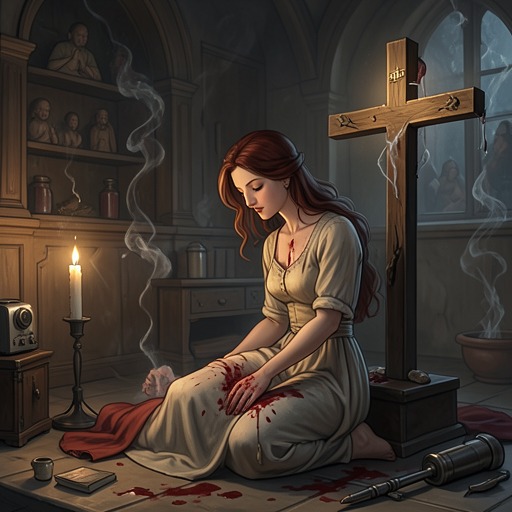
The Tale of the Vampire BrideDamnation is presented as a lived spiritual crisis rather than a verdict the narrative settles: vampiric transformation separates Ignatius from the church and the felt presence of God, while leaving him to hope that penance might restore what he has lost. Through his confession to Glynis Wright, and through the novel’s counterposed scenes of prayer, blood, and grief, damnation becomes a conflict over whether the soul can still be reached after the body has crossed into undead life.
Meaning and Limits
The novel does not establish that damnation is a final, objectively confirmed fate. Instead, it gives the condition particular force through Ignatius’s own account: he believes he has lost the spiritual life that once ordered his days, and he makes his continuing existence a quest for salvation. His language of hell and damnation records his anguish and religious understanding, not a narrator’s declaration that redemption is impossible.
Glynis Wright uses a related but distinct image when she tells Andrew Wright that, after her family died in the Carpathian Mountains, she entered a period of madness, hated her existence, and felt trapped in a personal hell. Her account links spiritual desolation to bereavement and captivity, without equating those experiences with Ignatius’s loss of the church. The distinction matters: damnation in the novel can name a religious wound, while the language of hell also gives voice to suffering imposed by violence and loss.
Ignatius’s Fall from Religious Life
Before his transformation, Ignatius describes a life shaped by devotion. As a boy he found solace in his village church, prayed there daily, and believed he would serve God. He entered the church’s care, studied and worked diligently, and embraced vows of celibacy and poverty. He kept his hair long as a reminder, modelled on Samson, not to love a woman or be weakened by the flesh. Later, as a village priest, he served the people around him: he sat with the elderly as they approached death and baptized newborns. His faith was not merely an abstract belief; it was expressed through a community and a daily vocation.
That life is overturned when a vampire woman visits him while he is preparing by the fire. She asks him for a kiss; he yields, and she bites his throat. After drinking from her in turn, he awakens unable to touch his crucifix or enter his church. He no longer feels God’s loving presence. The change therefore registers not only as bodily transformation but as exclusion from the places, objects, and spiritual certainty that had defined his former life. His anger and lust persist within the new condition, and he tells himself that, having lost his soul to sin, he may as well take pleasure in the woman who transformed him.
The crisis deepens when she asks him to help her return to her husband. Ignatius says he serves both of them to this day and loves them both, yet recognizes her request as the moment he understood himself to have damned himself foolishly. He vows to do penance until God once more allows him to feel the divine presence and return to divine service. He describes this endurance as his own personal quest for salvation: damnation, for him, is not a completed sentence but the torment of believing he has been separated from God while continuing to hope for restoration.
Blood, Prayer, and Sacred Practice
The novel places this spiritual crisis beside scenes in which Christian practice persists under vampiric domination. Antoinetta Wright, facing death, puts aside her journal, digs into the dirt and straw, genuflects, kisses her rosary, and buries it. She promises to pray to the Father, the Son, and the Holy Spirit, and to beseech the Blessed Virgin to watch over Glynis Wright and have mercy on her soul. The prayer holds open the possibility of divine mercy even as Antoinetta urges her daughter to drink and live. The juxtaposition does not erase the horror of that appeal: survival is bound to the very blood hunger that threatens Glynis’s humanity.
That tension becomes explicit when Glynis drinks from a goblet held by Vlad Dracula. Her sisters support her as Vlad repeatedly fills the vessel; after she has drunk her fill, he lowers her into blood while her sisters dance. The blood restores her body: wounds fade, her senses sharpen, and her heart begins to beat. Yet as the hunger recedes, her conscience returns. She recognizes that she has fed on innocents in the arms of her captor and tormentor, breaking her vow not to do so. The scene makes the blood ceremony a counter-image to Christian sacrament: it grants bodily renewal while leaving Glynis with the knowledge of what that renewal has cost.
The conflict around sacred objects also appears in the attack on the village priest at the castle. The guards approach as he chants, and one seizes the crucifix, struggling to wrench it from his grasp. The scene supplies no account of the priest’s inner state, but it stages a concrete contest over the reach of religious symbols in a world governed by vampiric power. Ignatius’s inability to touch his crucifix is personal; the priest’s threatened crucifix makes that rupture visible as part of the wider violence surrounding the castle.
Penance, Love, and the Unresolved Soul
Ignatius’s vow does not restore the former certainty of his vocation. He continues to serve those who transformed him, and his account presents love, obligation, desire, and penance as entangled rather than neatly separable. When he falls in love with Glynis Wright, he confesses that his earlier resolve has been shaken: he loves her in a way he has never loved before, and he feels no shame in that love, even as he fears what it means for his penance. His words reveal neither release from damnation nor a settled return to faith. They show the persistence of religious longing inside a life he experiences as spiritual exile.
That fear is sharpened by Astir’s prophecy. Ignatius believes Glynis may become the cause of his destruction, and Glynis, convinced that the prophecy will come true in some form, fears that she will destroy the person who loves her. Their love thus carries a spiritual danger that cannot be reduced to desire alone: for Ignatius, it threatens the penitential discipline through which he has tried to seek salvation; for Glynis, it becomes another burden of responsibility amid her own captivity and grief.
Damnation remains unresolved even after Glynis gains power over Vlad Dracula and leaves the crypt. Standing over Vlad’s coffin, she says that he is no longer her master, that he made her strong, and that she will remain bound to him because he understood her soul. She distinguishes that bond from love, declaring that another has her heart while Vlad has her soul. The statement does not define the afterlife or confirm anyone’s redemption. Instead, it preserves the novel’s central uncertainty: the soul may remain attached to people and powers that have caused profound harm, while religious hope and the possibility of freedom persist without an easy assurance of rescue.